1.31.2008

The (R)evolution of carpet (part 4 of 4).

This final part of an essay on the rise of the Georgia carpet industry originated as part of an email reply to a former colleague. This friend asked about the relevance of Tricycle to the larger message of sustainability. The gains of the carpet manufacturers didn't happen in a vacuum, they benefitted from and contributed to the broader technology, business and social environment. Understanding context allows a person, a company or a society to hold a mirror to itself and see its place in a big world. This understanding can provide a platform for a longer view.

PART 4

Like the carpet revolution, the computer/ internet revolution waited for the right technology, and then never waited again. In ten years it changed its industry so thoroughly that Big Blue is now a consulting company and no one under thirty even remembers when they built computers. Punch cards and tape reels are either antique store curiosities or the punch line to a nerd’s party joke. Collaboration and flexibility were the key advantages that allowed all manner of people to work together in creative ways. Computer users working together quickly adopted new technology and then changed that technology when it didn’t do what they wanted it to do. Because there were no established models for “The Right Way to Go About This”, they were unafraid to try new ways of production, distribution and of completely re-imagining the concept of the supplier and the customer. In fact, the very idea of "product" changed as processes dematerialized and data replaced physical objects.

It’s surprising that the Northern Mills, like IBM later, couldn't see this coming. There were examples of this going all the way back to the dinosaurs-- who, even though they were the top of the food chain, lost out to smaller, more adaptable animals. History is full of famous examples of light, fast and flexible armies defeating larger ones. But somehow, the revolution always seems to come as a surprise to the establishment.

There’s a new revolution, and though it won’t look like what’s come before, the catalysts will be the same: flexibility and collaboration. And it’s still a matter of scale. Each revolution happens faster and affects a larger group. The carpet revolution was a specific industry, while the computer and internet revolution crossed boundaries of business and industry. The next revolution will be a collaboration of business and society. We’re already seeing the signs; voices are telling us the World is Flat, teenagers in the Netherlands post video opinions for consumption three minutes later in Oklahoma City. A part-time political junkie writes a blog that ends the campaign of a presidential candidate. A housewife in Knoxville orders a computer from a call center in India and parts are shipped from Singapore to be assembled in Nashville and three days after she hangs up the phone a package service is at her front door with her custom-built computer. And a billion-dollar carpet company announces the adoption, at all levels of its organization, practices that benefit the environment. The revolution is going to be a world where responsibility and profitability are no longer at odds. Society will stop being the customer and business will stop being the supplier. When both sides collaborate and benefit that’s a partnership and like the carpet industry before it, the relationship leads to even greater innovation.

Tricycle is part of what’s coming. Tryk is a product that generates revenue, but it’s only a tool, and like any tool its value lies in the concept of what it can enable. Someone buys a hammer because they imagine a house, not because they just want a hammer. Tricycle creates and distributes the tools for collaboration and flexibility. By freeing carpet manufacturers and designers from physical samples you create flexibility, now a designer can work anywhere there’s a computer, without a case full of samples. And collaboration can only happen when both participants are speaking the same language. Tryks become that language by replacing words with pictures. And when landfills aren’t groaning under the weight of more carpet and when natural resources go untapped because demand isn’t there then society and business share the benefits of partnership.

It’s a small part of the revolution to be sure and this company’s contribution could be forgotten when that last piece of technology falls into place and the revolution stops waiting, starts picking up speed and moves the world. But how much would it be worth to claim even a small part as your own contribution?

1.30.2008

The (R)evolution of carpet (part 3 of 4)

This is the third of a four-part essay on the rise of the Georgia carpet industry.

PART 3

When a car is small, it’s maneuverable. It can fit places a big car can’t, it can turn on a dime and its costs (from manufacturing to maintenance) are generally lower. If the fledgling carpet mills in Dalton were anything they were small. The very success of the Great Northern Mills meant that they couldn’t easily change their production methods. They were locked into their investments. It was an issue of scale, and suddenly bigger wasn’t better. Once key technology was in place it took less than fifteen years for the carpet standard to shift to tufted over woven and for Dalton to eat the Great Northern Mills’ lunch. How did it happen?

The smaller companies in the south weren’t afraid to try new business models. When one business plan would prove ineffective the mill would close and simply reopen in a few weeks with a new plan. There was very little capital and many businesses were run in what were essentially shacks. Despite shoestring budgets, salesmen went out and convinced skeptical buyers that they were buying carpet from huge firms. Visiting buyers would be shown Dalton’s few large mills from a distance and told that there was where their carpet was being produced. Decades later, small, internet-based companies would present themselves the same way, on an equal footing and sometimes indiscernible (by web presence) from larger corporations.

Making the tufts of carpet stay firmly in place is now accomplished through a process called heat setting. Back then the huge lengths of carpet were washed in very hot water so the cotton face threads would shrink and bind the tufts. Though there were many mills all in competition with each other, there were only a few independent businesses capable of washing the carpet. So the various manufacturers were compelled to share the same limited resources and, as any college student knows, hanging out waiting on the spin cycle to finish is a great opportunity to strike up conversation. This environment fostered a natural collaboration. When one manufacturer made a significant innovation, it inevitably benefited everyone.

But the greatest benefit of the new industry’s flexibility and quickness was represented in the materials used in the production of carpet. Beginning with cotton thread, manufacturers searched relentlessly for alternative raw materials that could be shipped and assembled cheaper, produced faster and could represent advantages over wool which was still the standard. While luxurious and long-lasting, wool was expensive, heavy and difficult to clean. It also comes from sheep. A manufacturer could build a woolen mill wherever he chose, but knew the farther away from the sheep he was, the more expensive the shipping costs of the raw materials. Synthetic materials like rayon and nylon were cheaper and resisted staining, and production facilities could be built anywhere. Companies like Dupont had produced synthetic material in huge quantities for the war effort, but in peacetime had difficulty finding a market. The arrangement for tufted carpet benefited both industries and instead of a traditional supplier-customer relationship, the resulting partnership led to greater innovation.

It was the same for backing materials. From using cotton duck which was the low quality filler in jackets and quilts to jute imported from India as the backing material, manufacturers experimented with every possible combination of materials. When civil unrest threatened the Indian jute supply the manufacturers quickly turned to domestically produced synthetic materials like latex and foam. Like a small car, they could match the shifts in the market turn for turn in a way that the larger companies couldn’t hope to achieve. It was a new world and a smaller platform, proved better at adapting. (to be continued...)

1.29.2008

The (R)evolution of carpet (Part 2 of 4)

This is the second of a four-part essay on the rise of the tufted carpet industry in North Georgia. While it's easy, in hindsight, to consider that growth destined, or inevitable; it came about despite numerous obstacles. Though technology can provide the means for growth, growth itself, through creative problem solving, drive and passion can only come from committed people.

PART 2

The American textile industry traces its roots to the very founding of this great nation. Weavers and looms and techniques came over from Europe. Mills were built and business went on in America much as it had in the old countries. There were a few changes, for example, as the American textile producers grew; they stopped purchasing raw materials from European middle markets and established their own direct supply chains. And patterns and techniques inevitably developed that were distinctly American. Alternative raw materials were tried with very limited effect. The public bought wool because that was what dominated the market and the mills made woolen products because that was what the public bought. The advances of the industrial revolution occurred roughly parallel on both sides of the Atlantic; so the big, established industries kept doing things the same way they always had and everything was fine—if a little bit boring.

Remember our socially awkward Catherine Evans? Well she eventually married, but apparently didn’t develop many other interests. She kept making bedspreads and began selling them to local general stores. Interest locally was good because of the low cost but there was also demand from outside the community, partially due to a small national trend at the time toward folk art and goods. When demand became too great she taught others how to make the bedspreads and soon many households were laboriously turning out bedspreads. In fact the cottage industry came to be many households’ primary income and cars speeding down the road at night (heading to Dalton at least) were more likely to be rushing more yarn and cotton to busy home businesses than carrying bootleg whiskey.

Could this have been one of the first modern examples of a collaborative business effort using an open-source platform? Let’s go back to our comparison, the internet revolution started quietly. Everyone knows now the internet had been around for years before two key events happened at just the right time. The introduction of the Windows operating system was the first event, followed by the first web browser program. One was a commercial business product; the other was written and disseminated at no cost but both represented the arrival of technology that could deliver product on demand to a wide audience in real time. McDonough and Braungart call this a “technology key” and the Georgia Carpet Industry was waiting for one to unlock its own revolution.

What was happening in North Georgia certainly caught the notice of the carpet mills in the north but the potential competitiveness was easily dismissed. The small Georgia mills weren’t following any established production models, they were using the wrong materials (cotton yarn instead of wool) and they were tufting instead of weaving. The northern mills even allowed representatives from the south to come in and tour their facilities and to take ideas back to incorporate at home. Growth was steady but slow, the carpet industry’s technology key was just about to arrive. That happened thanks to two men working separately who produced the first modern carpet tufting machines. These men, one named Carter and the other Cobble developed machines that allowed mass output faster, requiring less labor and less cost. But even before Carter and Cobble arrived with their innovations, resourceful people were purchasing used or broken Singer sewing machines and modifying them to take larger needles to punch though the heavy material and to handle the bigger scale. Like the internet pioneers would later do, the carpet innovators were quick to adopt new technology. And when the technology couldn’t meet their demands they adapted that technology to keep up with their needs. And like the Big Computer Companies would later do, the Great Northern Mills saw the revolution coming, even provided assistance, and never recognized it for what it was until too late. (to be continued…)

1.28.2008

The (R)Evolution of carpet (Part 1 of 4)

When I first arrived in Chattanooga and at Tricycle I understood that I had a great deal to learn. While I was familiar with “green issues” the contexts of carpet manufacturing and sustainable design were new to me. Fortunately for my learning curve, there was no lack of resources from which to draw. In the Tricycle library I found a copy of Thomas Deaton’s book: Bedspreads to Broadloom: the Story of the Tufted Carpet Industry. This history of the Georgia carpet empires and their unlikely beginnings proved to be first enlightening, then a valuable reference in understanding the subtext of the fierce competitiveness and neighborly resource sharing happening, often simultaneously, in the manufacturer’s rows of North Georgia.

I also noticed how the story of the growth of tufted carpet seemed familiar in the way that seeming obstacles (like geography and resources) became agents of innovation instead of barriers. I knew I’d heard this story before and I wrote this essay to help myself better understand what I was learning.


I've split the essay into four parts and will post them over the next few days.

PART 1

Carpet is big business in Dalton and the surrounding communities. Manufacturing facilities all located within one hundred miles of Dalton produce 70 per-cent of the world’s tufted carpet and bring in over $11 billion in revenue. In contrast to its unremarkable beginnings, the story of that growth is completely, wholly amazing. In fact one of the truly surprising things is how closely that story follows the story of another, later revolution that rose from humble beginnings to shake and then dominate the very industry that had dismissed its potential—the computer and internet revolution.

The carpet industry had remained virtually unchanged for one hundred years. Weaving was the method and wool was the medium. There was so much investment, and sales were so lucrative that there was little motivation for change. The established industries resisted rather than encouraged innovation. Think of the existing carpet industry at that time as IBM—Big Blue. For decades IBM was the largest computer company in the world. The company that famously stated the future of computers is in hardware and that no one would want a computer in their home. Like the computer giant would later do, the carpet mills couldn’t imagine the world would change simply because it hadn’t yet.

In 1895, a fifteen year-old girl named Catherine Evans made a bedspread. This event would have gone entirely unnoticed because quite frankly it was precisely the kind of event people tend not to notice. But something happened, two things that were uniquely, remarkably boring. The first is how Catherine made her bedspread. She purchased the muslin squares and the cotton yarn and began to sew it all together. She used part of the yarn to make large looping stitches to emphasize the pattern. Then using household scissors, she cut the top of the loop creating two tufts of thread from the single loop. She unraveled the twists of yarn and spread out the tufts to create a textured pattern on the face of the bedspread. This technique was called “tufting”.

The second thing was where this happened, in North Georgia just outside of Dalton. At a time when the city of Atlanta, which would go on to become one of the nation’s most important urban centers, was still a backwater, Dalton had even less to recommend it. There was little infrastructure, few manufactured goods were produced locally so products were shipped in. And while Dalton was the home of two textile mills, the only real industry was the foundries over the state line in Chattanooga, Tennessee (see, boring, but stay with me).

There’s nothing efficient about making a bedspread in this manner. The investment of money for material and thread, the extensive time required, not to mention backache and cramped fingers meant that while the tools and materials were commonly available not many people produced these goods by hand. Even in the south, most people purchased woven textiles produced in northern mills from imported raw materials. But Catherine, after making the first spread, actually did do something remarkable—in a way. Ignoring the difficulties and slow pace, she began working on another bedspread, and another after that. So thanks to a teenager with a stunted social life, the Georgia Tufted Carpet Industry was conceived. And though the event happened with little notice there was a bit of fanfare. The second bedspread was a wedding present for a sister in law and though by all accounts the wedding was a modest affair it’s worth mentioning here because everything else up to this point had been so perfectly boring. Outside the local community the wedding passed without notice as did the gift of a hand-made, tufted bedspread. And although the great Northern Woolen Mills didn’t know it, they were on borrowed time from that point on. (to be continued…)

1.24.2008

Earth-tones are back


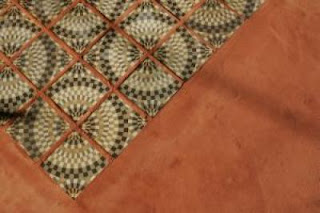
In the search for new trends, designers often turn to the past for inspiration. In searching for new materials to use in “green buildings”, builders, renovators and home owners are looking to the past as well. Products incorporating natural materials can be found in furniture, wall coverings and flooring. Now it’s possible to incorporate what may have been the original floor covering, dirt.
Now certainly there are parts of the world where earthen floors aren’t a design option as much as the only option and granted, the floor treatments offered by companies like From These Hands, LLC have little in common with a bare earth floor. Still, there’s no question that the materials used are natural and sustainable. The mud is compacted with straw and other fibers and finished with a drying agent such as linseed oil. Any waste from the project can be reused in another earthen project. And if properly sealed, the floor can last as long as other conventional floors, according to From These Hands owner Sukita Crimmel.

And while the installation process is time and labor intensive, at $7 a square foot—especially compared to other green flooring materials—the cost for an earthen floor is, well… dirt cheap.

I'm cancelling eco-consciousness due to exhaustion

An amazing, refreshing spoken word poem from Dawn Maxey:

Global War

LauraMae Bryan. She was the most popular girl in Mrs. Magnani’s 4th grade class—the coolest thing since Maytag refrigerators. She’d say things like, “Oh I’m sorry, you mean you don’t have the new etch a sketch? I do!” I couldn’t wait to grow up and get away.

But then/ just the other day,

I began to notice people at Whole Foods with entire shopping carts full of ‘organic’ and ‘go green’ items. These people are the same ones that say things like “did I bump into you? I’m sorry. I just didn’t expect this ENVIRONMENTALLY SAFE dishwashing soap to be so heavy.”

I want to pour environmentally safe salt in their eyes.

I don’t know who these people are
but they’re growing out of control.
pressuring well meaning citizens into buying
more, more, more,
all to pollute less, less, .. less?

being green is the new cool
and even Kermit can’t keep up
suddenly I feel pressured to buy solar powered nose hair trimmers and
I don’t even have that problem.

In fact, I imagine a day when things get so bad you’ll live in a glass house so that everyone can see you wake up in the morning, get out of your organic soy bean bed and pack your “this is not a plastic bag”, bag. You’ll open a box of Tony the tiger’s non hydrogenated hypoallergenic free trade grain flakes, and drive your not-tested-on-animals bicycle to work. Then you’ll help Nike ‘save’ the rainforest by branding large red swooshes on all the lemurs or maybe organize a photo shoot for Abercrombie’s new cotton free cotton underwear.

But really now. Hipsters have taken this way. too. far.

Especially with the Prius.
See, it’s gone from a Pri-us to a Pri-ME.
because
it’s all about how cool I can be
In fact, I’ll buy seven
so I can drive a different one each day
it’s all about ME
pri-us to a
pre-me to a
pre-me-um.
a premium.

another excess “thing” in our lives that piles up and nobody ever looks at again.

Green is chic now, but when the stock market of trends crashes

no one will want to be caught dead with biodegradable polos, environmentally safe dirt, or toilet paper made from corn husks.
the earth will be just as trashed as Lindsay Lohan in a Bacardi factory
and people will care
even less

So how do you fix the problem?
Make being green
sustainable
show people that it’s not hip or trendy or fun to be green
it’s an obligation

turn ME into SENSIBILITY

it’s logic we should have learned by the fourth grade

having three hybrids does not equal less pollution
George Clooney is not the world’s expert on recycling
buying organic blueberries from Chile uses up a lot of pricy gas

there is no such thing as free range carrot sticks
don’t give in to the power of trends.

but hey, hip can live up to its hype
live earth was groundbreaking
the truth was inconvenient
and by all means,
captain planet was a really cool guy

but when you combine campaigns and corporations
with a heavy dose of
good brains and obligations
the change will last so long
the energizer bunny will cry himself to sleep

Green is not hip, or trendy, or fun.

It’s an obligation.

1.07.2008

Not Your Average Scratching Post

Hopefully your cats didn’t spend the Christmas season batting at glass ornaments, climbing the tree, and getting hair all over the tree skirt. Unfortunately, mine did all of that. And it made me realize that it’s time to purchase a new scratching post or cat tower or anything else to keep them entertained and busy the two hours out of the day that they aren’t sleeping. As much as I love my cats, I’m not putting one of those carpet covered, four foot high trees in my living room.


I knew instantly what we needed when I was sent an email about the moderncritter bent plywood cat scratcher. It’s a simple 5/8” thick molded plywood piece covered in natural walnut veneer with a clear matte lacquer finish. And the coolest thing is that the scratching surface is just two FLOR carpet tiles.


Eco-friendly carpet mixed with stylish, modern design; what more could you ask for? The cats will love it and your guests won’t laugh at your décor. If you are especially crafty, you could tackle a similar project (without bending plywood) by using old carpet samples or remnants you have lying around.

Or if you are a designer with said carpet samples lying around, make your own while reducing waste to the landfill or causing trip hazards in your resource library. We are launching our second annual Ample Sample contest in February 2008, so we would love for you put those carpet samples or Tryk™ prints to good use as well. You can view last year’s winners here for inspiration, and details for 2008 entries will be posted soon. The winners will be promoted at NeoCon and in Floor Focus magazine. Maybe you could be the next person selling $315 cat scratchers…

Our blog is mostly about sustainable design in the interiors industry,
especially carpet. Sometimes it's just about us. Updated when we've got something good to say.