We love San Francisco's decision to ban disposable plastic shopping bags, but it would serve us well to remember that the marketing push for their adoption in the first place, ten years ago, was environmental concern.
In 1999, the US was responsible for the felling of 14 million trees to produce 10 billion paper shopping bags. According to Treehugger, the total energy used and pollutants produced by every paper bag is nearly twice that of plastic... thus the push, not so long ago, for eco-friendly plastic. Although Treehugger also points out that now we're seeing more than 100,000 birds and animals die each year from an encounter with marine debris, much of it plastic bags.
Being between a rock and a hard place is nothing new for sustainability activists. Let's run our cars on corn? Great! Much better than nonrenewable and ozone-killing petroleum. But what would the impact of higher corn demand be on American farmers? Particularly those who are committed to growing crops without high yield genetically modified seeds or petroleum-generated fertilizers (if you haven't yet, read Michael Pollen).

OK, then, what about sugar cane? It's a more efficient source of ethanol anyway; in Brazil, the world's largest producer of sugar cane, ethanol-only and dual-fuel cars have been sold since the 1980s. But what percentage of their sugar fields were once rainforest? And how much more would be clear-cut if Americans clamored for sugar cane at the pump?
So are we simply damned if we do, damned if we don't?
Well, there are great causes for hope. One is the rise of true lifecycle analysis: smart ecoveterans around the world are pushing hard to subject the full life of a product to intense scrutiny... not only in the classic understanding of "lifecycle" (from materials to market) but all the way from design to disposal/reuse. This helps us avoid false dilemmas such as "Paper or Plastic?", and leads to big shifts such as what's happened at IKEA. Last year, IKEA became the first major US retailer to begin charging customers for plastic bags - with the stated intention to eliminate their use entirely - while at the same time cutting the cost of their reusable "Big Blue Bag"s from 99 cents to 59 cents. Until their customers catch on and start bringing their own bags, the company is donating profits from the 5 cent cost of each plastic bag to American Forests, to fund the planting of trees to restore forests.
But the best reason to be optimistic is the continually growing groundswell of re-thinkers who don't assume that just because an advance is brought to market, that it is "the answer". Who know that sustainability is not a destination, but is a matter of steps in the right direction. The market has always had a voice (it's our own fault that we're in today's consumption nightmare), but buyers are now acutely aware of their ability to shape supply. And want to use it for good.
This ties into a trend that is top of mind for marketers today. Brand loyalty isn't as much of a decision maker as it was a few years ago. Car shoppers can buy a quality product from BMW, or Audi, or Honda... or even Kia. It's said that nearly 70% of consumers can be swayed in the store re: which product to buy. There are, of course exceptions. Cigarettes, for example. Smokers are fanatically loyal to their Camels or Kools. Maybe we're all protective of the things we love, that hurt us; the Late Great Vonnegut once called smoking the only socially acceptable form of suicide. But smoking isn't quite so cool anymore (and curiously enough, dying is much less trendy than it was a decade ago). Today it seems that its much cooler to live, and help others live.
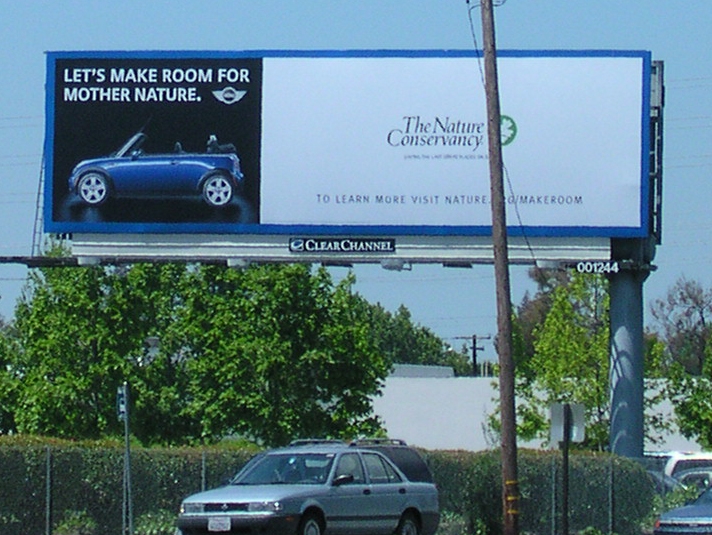
And brands that are thriving most today are ones partnering with causes beyond their brand. Mini and Nature Conservancy share billboards (and messaging). Greenbuild is growing by leaps and bounds during a time when many interiors expos are dying on the vine, or struggling to reposition themselves.
Or the glory story: the Project (RED) campaign, which is brilliant because it takes all comers and uses their products, motives, everything, for good. As the associated brands are clamoring for attention, as actors scramble to be included in the latest photo shoot, the full weight of the marketing machine truly is helping save lives. I was in New York this week at an eco-savvy fashion show and saw one of the überhip models wearing an übertiny HAMME(RED) t-shirt from the Gap. At first, skepticism kicked in and I wanted to poke a bit of fun at the apparent incongruity between his context and the (RED) context, but I stopped short. Irony was trumped by the cause. Whatever his reasons for wearing the shirt, whatever Gap's motivation, the fact is that his shirt provided 41 doses of nevirapine treatments to a pregnant woman in Africa, to prevent the transmission of HIV to her child. And this is something wonderful.
Frankly, I believe that consumers don't enjoy being skeptical. It can be fun and funny, but it was much more fun to have my mouth shut by the truth of the (RED) t-shirt. Because like many people out there, I love to be surprised by truth and goodness.
Corporations aren't incompetent - far from it. And they go where the demand is, shaping it along the way. It'll be interesting to see how branding responds to a market that refuses to choose between X and Y. We'll see more brands unite around sustainable causes, for sure. Hopefully their ad budgets will help reduce environmental and human injustices (here's a starting point: fashion has always depended on developing nations. Some work to be done there). At Tricycle, we're glad to be associated with many groups that promote sustainable causes, because these relationships offer more situations where we can push for reducing unnecessary design waste, and continue to insist that something that is not made cannot be wasteful.
And where, perhaps above all, we can continue to promote transparency in these organizations. Because the company that says the same (true) thing in public and in private will move forward, while others find themselves backpedaling through backlash.
“Sound Off” is an op/ed post by editors of the Tricycle blog. The opinions may or may not reflect those of the Company. Caleb Ludwick is communications director of Tricycle, Inc. He now owns a (RED) t-shirt.