James Howard Kunstler
Last week I had the opportunity to see James Howard Kunstler speak in
Last week I had the opportunity to see James Howard Kunstler speak in
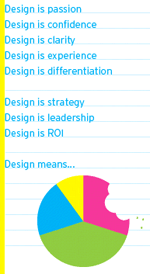
Well, Michael is presenting at AIGA's GAIN design and business conference, as I type this. Huge thanks to Interior Design for helping us broadcast our message about sustainable design (as they have so many times before) and to Edward Tufte for teaching us all how to create slide presentations that are content+format.
And, of course, to AIGA for creating a platform where designers can talk about shaping business strategy and rethinking the creative lifecycle of products.

What if there were a quota of carpet samples in the U.S. and each SIM produced actually prevented the creation of a carpet sample from that pool? As nonsensical as this may sound, principles of this model are in place in Europe due to the Kyoto Protocol.
The European Union has created a climate change mechanism called The EU Greenhouse Gas Emission Trading Scheme that produced a pool of Carbon Dioxide points and assigned quotas to over 10,000 businesses in member countries which must purchase the emissions points — sort of a CO2 debit card. Interestingly, individuals outside of these organizations can purchase these points and therefore prevent any other entity from using the CO2 credits. The Science Museum London has packaged a Climate Relief Pack which contains an EU Carbon Emissions 100kg Carbon Credit certificate which “cancels” a portion of the EU quota available to big businesses — in effect a means of ensuring clean air through a £19.99 purchase. Though we have carbon offset programs in the U.S. they use donations to purchase alternative energy or plant trees. They don’t actually prevent anything like the Climate Relief Pack.
The elimination of waste is much easier when it’s never created. This is what we call dematerialization and though we've been using the term for a while to explain what we do, we're finally hearing it more from outside sources… and BIG ones at that. A rather heady, but interesting article on the subject can be found here 0n AT&T's corporate web site.
Thanks to Andy in our Leeds office for the EU explainations.
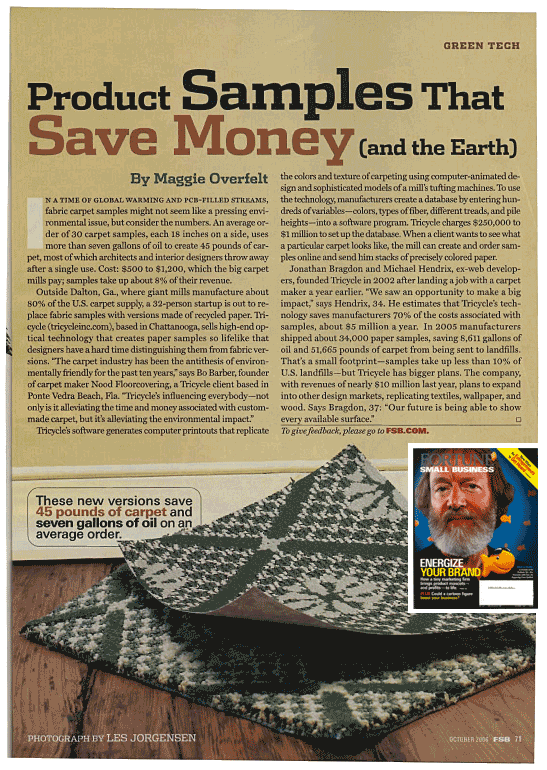 The October 2006 issue of Fortune Small Business highlights Tricycle in an article entitled, "Product Samples that Save Money (and the Earth)" by Maggie Overfelt. Click on the title to read the online version or the image thumbnail to review the print version.
 On October 27th I'll be presenting on behalf of Tricycle at the GAIN: AIGA Business and Design Conference in New York. Four years ago, with Tricycle only a month old, Jonathan Bragdon and I attended the same conference in Minneapolis. The theme of "design" as a primary business strategy resonated with me. After all, that was a driving force behind our new venture. We had a motivating belief that changing the carpet industry (in our own backyard) was possible. And that we'd do it through a combined skill set of technology, design and marketing. My personal motivation was even deeper. I was looking for a way to make graphic design more meaningful. The opportunity to apply design thinking to a an entire industry was (and still is) exciting.
Today we have a significant number of the world's leading carpet mills as customers. Even more satisfying, we have a client that has built his company upon our vision for industry change — a result of ongoing success with the "big guys". I've invited Nood's founder to share the stage with me at GAIN and to discuss our designer/client relationship. I believe there's no better "proof of concept" for the Tricycle vision. Visit this page and scroll down to "Michael Hendrix" for a presentation description.
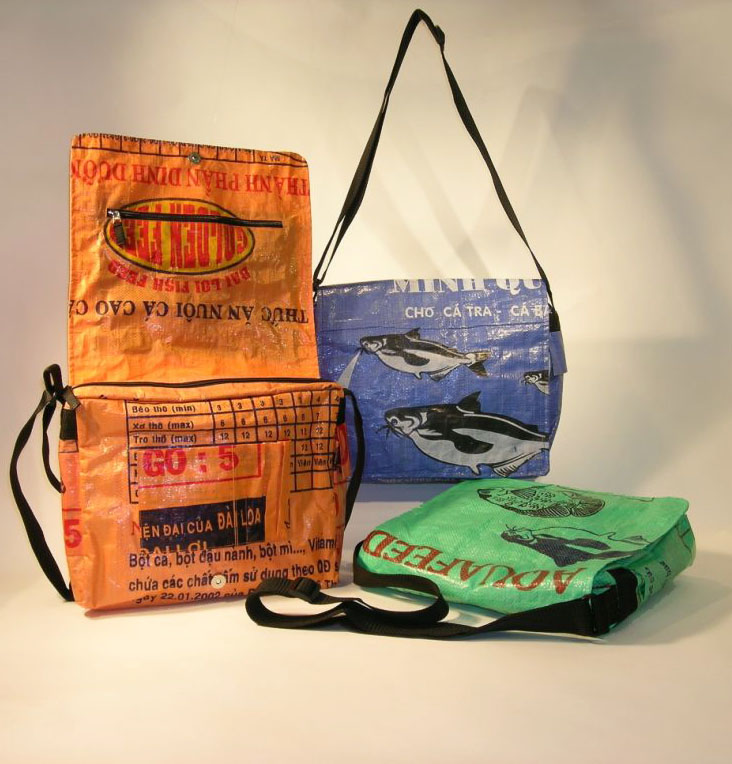
And here’s yet another example of a waste stream that has been diverted in a way that serves not only function, but also form.
In Cambodia, thousands of plastic bags that carry rice, fish food or other commodities pile up in trash heaps. Gecko Traders has started recycling these bags into fashion accessories that have a market in Western countries. And even better... Gecko is built around fair trade principles of offering wages and good working conditions to disabled and disadvantaged women who are victims of landmine detonations or wartime displacement. Find them in Chattanooga at Canvas Canoe.
Like Anj’s post below... and like our SIM print carpet samples... these are things that have come into existence because someone refused to accept greywater from sinks, or plastic trash, or starving refugees as necessary evils. Sometimes it takes a second look to see these things in a different light. There are examples all around us: I was chatting with Ben Horner, our design director, the other day and he asked me: “What if it were a rule that anyone who went shoe shopping had to go barefoot?” That’s an even better solution than recycled content shoeboxes.
We should push toward a greater day when poverty is no more, and when thousands of bare feet are seen walking down Madison Ave. But in the meantime, by taking a second look, maybe we’ll find good ways to give waste a second life.