7.27.2006

Plinth&Chintz Podcast talks up Tricycle


If blogging is the new television, then podcasts are the new talk shows. And one of the coolest design podcasts around, Plinth & Chintz, has given us a pod-nod. We feel very mod (and famous).

Click here to listen to Plinth & Chintz talk about NeoCon, and their opinion of Tricycle's SIM samples as well as the Zoom Room we built for Bentley Prince Street.

Other manufacturers who used SIM from Tricycle to show their wares at NeoCon are Antron, Aquafil USA, C&A, Crossley, Durkan Commercial, Interface, Karastan Contract, Lees Carpets, Mannington Commercial, Mohawk Commercial, Monterey, Nood Floorcovering, Shaw Contract, and Solutia/Ultron. To find out how to hook up with these and other manufacturers, check out our manufacturer links page.

Sustainable design = at Tricycle, tech is a means to greater ends.

Stealing Ideas


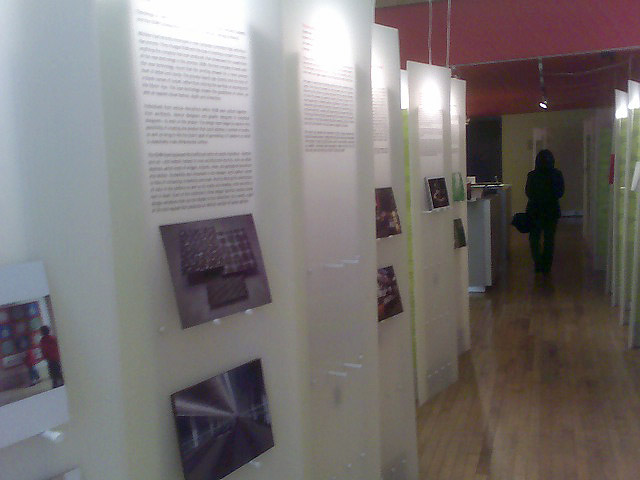
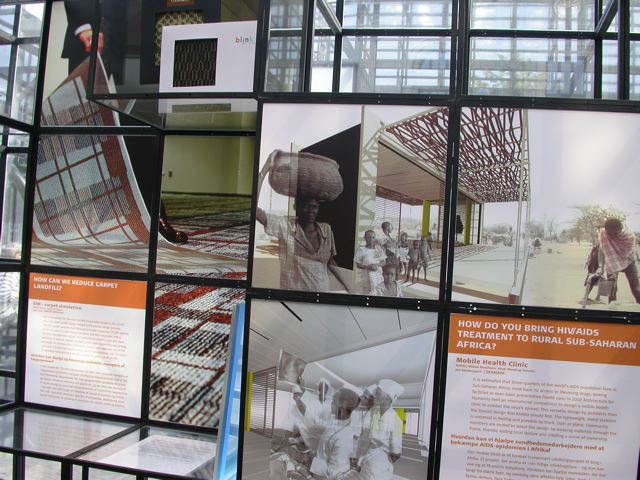
After 6 months I finally bothered to download some photos from my cell phone. I snapped this one while visiting the AIGA gallery in New York this winter. Our 2004 NeoCon tradeshow booth was on display as part of the AIGA Year In Design 26. As I approached the Environmental Design section, I discovered the photos of our exhibit were missing from the display (exhibit A). A brief conversation with the docent revealed that a design class had just toured the gallery and one naughty student had secretly swiped our photo boards. I award an "F" for flattery and an "D" for dematerialization.

7.26.2006

Snobbery and Scooters


I recently joined the few and the, err, insecure.... the scooter owners of America. I can’t really pinpoint why, but here, scooters aren’t considered the hippest of transportation options — even if they make the most environmental and economic sense. I have to admit that I even had reservations about owning one. It may have been due to living in the truck-centric South or just the fact that they don’t bow to the god of speed in the country that created car culture.

But after two months with my Buddy as my primary means of transportation, and a 90mpg average, I have no regrets. I’m further bolstered by the “normal-ness” of it I’ve witnessed in Europe and India. So normal in Paris that a sign had to be posted to keep visitors from taking them up the lift in the Eiffel Tower. I hate to think that we’re so macho that this very viable transportation is overlooked due to lack of “intimidation appeal”. And yet I confess that those reservations played a part in delaying my purchase. Even though they’re gaining in “hip factor”, it’s in the realm of Thom Yorke dancing rather than Johnny Cash singing — admiration rather than respect. Now, after joining "the club", I've discovered there's a code for cool versus lame among local scooter enthusiasts based upon make and model (even if more modern stylings have lower emissions). I guess some two-wheelers are sissier than others. God help us if our will to drive a cool vehicle is stronger than our will to cool the planet.

7.20.2006

Softest Shoes on the Planet


Something grabbed our attention today: one of our customers, Nood Floorcovering, sent out a press release about an installation of their cool faux-flokati tufted flooring Spork being installed in a shoe store called Zümfoot. One of the new shoe brand’s features is their push toward better “eco friendly manufacturing... materials and technologies.” Their leathers are vegetable tanned instead of being tanned by conventional chemicals (which leaves a smaller environmental footprint + a finish more resistant to perspiration). Also the cork in their footbeds is rapidly renewable and they use 100% recycled paper shoe boxes, pamphlets and brochures.

Shoes? Yes, shoes. Oh, that foot voodoo they do.

Graffiti shoes, sustainable shoes, reused shoes, economic development via shoes. Perhaps so much happens in this sector because the product are on nearly every pair of feet that work in the Western marketplace. Nike is not only using water-based glues in eco-marketed shoes, it is even sharing the technologies with Timberland.

And we can’t help but think... shoes certainly get a lot of wear; could this glue find use in other products? Hmm... read here about a great step in the right direction!

7.13.2006

Business Week Says SIM is a Gold-en IDEA


Today Business Week and IDSA announced the IDEA Gold winners, the best product designs of 2006. We won the Gold in the EcoDesign category, with Haworth and Herman Miller receiving Silver and Bronze respectively. Wow!!!!! Quick, run to the newsstand and get the July 10 issue! Or be a hipster and read about the awards beforehand at Business Week.

Dematerialized Brand: Tricycle as a Case Study


Live/Work wrote an interesting article on Treehugger about the brand value of Tricycle based upon what we enable our customers to do. It was picked up and expounded upon by the editor of Fortune mag's Innovation Forum.

Sound off 2: More of the same... (part 2)

“Sound Off” is an op/ed post by editors of the Tricycle blog. The opinions may or may not reflect those of the Company.

(... continued from part 1)
Lots of articles have examined the reasons why cause-led design is coming to the fore, so let’s peek at some of its effects. First is a backlash against a culture that has recently defined worth by celebrity status, and the creation of space for a celebrity of ideas rather than of personalities. When Brad Pitt recently narrated a PBS series on Green Design, the benefit seemed greater to the Pitt “brand” than to the Green Design movement. The result is that products that are great but might otherwise suffer anonymity and failure can make a real difference by tapping a timely cause.

There can also be real benefit to society. As the editors of Contract magazine said so articulately in their May issue, “Social awareness is at the core of good design... In 2006 the social responsibility theme resonates strongly not just in the design community, but throughout business and industry in general. In light of the devastation we have witnessed multiple times in our own country, along with enormous global issues, we are collectively impressed by the needs of many” (p54). Organizations like Architecture for Humanity are gaining attention like never before.

Curiously, however, sustainability was a contributing factor to the boredom at NeoCon. You couldn’t throw a stick in the exhibition halls without hitting... well, a stick. It seemed that every booth featured something green, or woody, or a clever tagline to catch the eye of sustainability-minded designers. And there was not a whole lot of transparency on the actual environmental footprint of products... which meant that booths that clearly presented hard data really stood out.

Sustainability isn't about billboard marketing. In fact, designing with sustainability in mind is a great way to keep it from becoming boring, more of the same-old same. Consumers like hearing the truth about manufacturing, especially if it’s a step in a good direction. And the need to create new and better materials mean that we are being offered raw materials for design work that are more interesting. And with better materials, the output of design projects have a great reason also to be more interesting (dare we say, inspiring?). Because designers find themselves asking timeless questions -- we are innovating, we are creating, we are pushing toward something. But toward what? And what if great things are possible?

To me, the greatest change away from boring recently has not been in products or in product marketing, but in buildings. Buildings are a great litmus test, because they are one of the few manufactured products in our economy that are built to last. We’ve heard about planned obsolescence and single-serving products for years, but it seems that today this been taken to new levels, where old products are being relaunched based on buyers’ lifecycles. E.g. my dad took me to see Superman in 1978, and I could take my kids to see what’s largely a re-write of this original, today. My daughters love My Little Pony -- launched in 1982, with a brand re-launch in 2003. See also The Longest Yard in ‘74 and ‘05, Willy Wonka flicks in ‘71 and ‘05, even the Texas Chainsaw Massacre in ‘74 and ‘03. Or the resurgence of Strawberry Shortcake (‘80) and Care Bears (‘81). UGH!! In a few years, watch for the Teenage Mutant Ninja Turtles to hit theaters and Toys’R’Us.

Buildings, by their nature stand, in stark contrast. They are not built to be re-built in five, or even twenty-five years. As the Chair of LEED for Commercial Interiors has said, they are designed to last on this earth for longer than my lifetime. And in contrast to twenty-five years ago, buildings are being constructed in ways that are radically better for their environments... for their interior environment -- dovetailing with beautiful and ecologically savvy advances in interior design -- as well as for the human and ecological communities surrounding their footprint. Better materials used in better ways, to better ends... where ‘better’ isn’t just marketing spin, it can be explained and marketed (even at trade shows) in ways that demonstrate economic, environmental and social profits. To paraphrase Tibor Kalman’s classic quote: where design is not an end in itself, but a means to an end.

Caleb Ludwick is Communications Director at Tricycle, Inc.

7.07.2006

Behind Curtain #1… ZoomRoom™

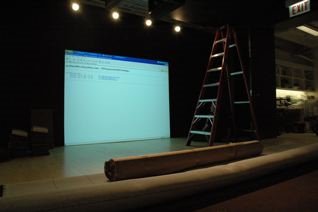
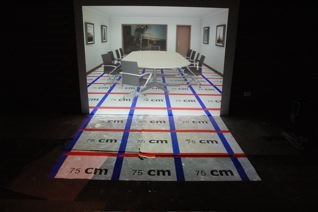
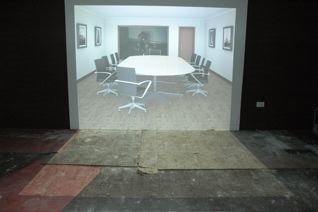
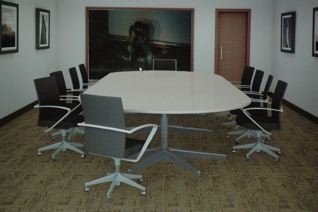
Here are some "behind the scenes" photos from our ZoomRoom™ debut in the new Bentley Prince Street (BPS) showroom located in the Chicago Merchandise Mart. ZoomRoom is a new product we designed as a full-scale showroom and retail visualization tool. Rather than confining patterns, textures and objects to a computer screen, they are projected on multiple surfaces in a life-sized environment in front of, below and around a viewer (and in the case of BPS, we used SIM of course). It's a better shopping experience because sample swatches and furniture photographs can't give an experiential sense of scale.

ZoomRoom is simple to use because it's based upon a barcode and scanner system. A user selects a swatch of the product she is interested in. She scans its barcode and the product appears in full scale on the wall or floor in front of her. Additional cards (similar to children's flash cards) are scanned for further operations via an integrated online tool; from her home computer, she can email the images, coordinate with other products and colors, print, and place orders.

These photos were taken while Matt was setting up in Chicago this May.

7.06.2006

Sound Off 2: Can green save design from sameness? (part 1)

“Sound Off” is an op/ed post by editors of the Tricycle blog. The opinions may or may not reflect those of the Company.

This year was only my 2nd Neocon, and when I arrived I was still a bit awestruck by the prospect of 1,200 product exhibits covering 1.2 million sf of space. So I set off on Tuesday morning to soak it in. I started out overwhelmed (and enjoying the feeling), but quickly my interest was dulled. By the time I’d walked two floors, it was just plain dull.

Product overload? OK, maybe... but something else too. Although there were many interesting products, there were very few exhibits that stood out as remarkable (Maharam's showroom was like a lighthouse in a sea of sameness). In truth, most of the exhibits looked like something bought out of a box at Target.

Don’t get me wrong, I like Target, that poster child for democratizing design. I’d even take things a step further and say that, by and large, Target is democratizing good design. Affordable good design? Yes, please.

But if we picture good design spreading like oil on water geographically and demographically out from major metro areas, we can’t help wonder who is shaping its form and future. We’re losing the old channel of distribution of design ideas, where mass fashion follows and mimics rich folks. In fact, P.Diddy lifestyle is for sale through Bloomingdale's (although in wrinkle-free and stain-resistant versions). My question is: since way that design ideas are distributed has changed -- at least for the present -- who is leading fashion into its next phases?

I suggest that social cause-based design is leading. In fact, new notions of class distinction are a great example: street design is not about slumming, it’s about the commodification of individual expression and protest, much like the blues morphed into rock in the 1950s. Note that street designers’ launches emphasize new labels rather than new products. An interesting concept -- the commodification of individuality and uniqueness -- but one with no lack of marketability.

Sustainability, the hot button in the interiors industry right now, is another example. In a time when many expos are struggling, attendance at the USGBC’s Greenbuild has more than doubled every year to last November’s crowd of ten thousand plus. Award competitions are re-shaping: this year, Business Week and the IDSA added Eco-design as a permanent category to the prestigious IDEA awards.

coming soon... part 2

Caleb Ludwick is Communications Director at Tricycle, Inc.

7.03.2006

INDEX:awards 2007


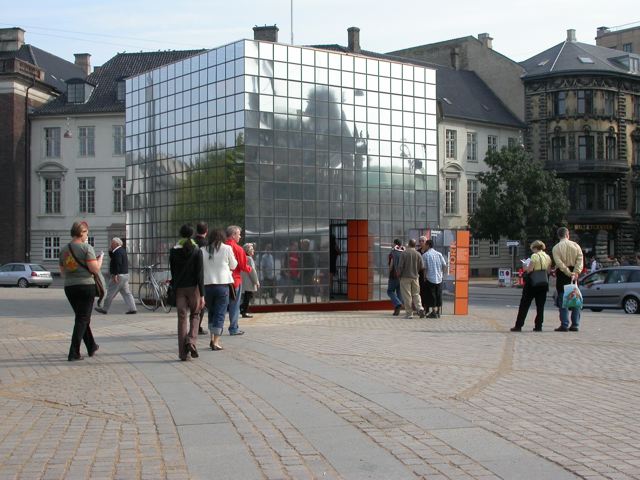
Nominations for the 2007 INDEX:awards for Design to Improve Life are now being accepted. We had the fortune to make the shortlist and exhibition in 2005 and to attended the ceremony in Copenhagen last September.

It's a unique design competion with unorthodox categories, a HUGE cash prize, and a creative approach to public display. The large mirror cube pictured here was one of five exhibition spaces placed throughout the mall in the shopping district of Copenhagen. Each nominee had a small display inside (ours modeled here by fellow Trikers). Their strategic placement made the cubes ideal curiosity stops for wandering shoppers. Visitors were encouraged to visit all five pavillions and cast a vote for the "people's choice". It was a genius marriage of public sculpture and interactive exhibition.

There are "sanctioned" world-wide nominating bodies (like AIGA who nominated us), but J.Q. Public can make a nomination as well. Nominate yourself or a company/product you love. It takes a little homework but Hella Jongerius may think you're genius.

7.02.2006

Sound Off 1: Hendrix on 'Sustainable Design'

“Sound Off” is an op/ed post by editors of the Tricycle blog. The opinions may or may not reflect those of the Company.

Tricycle is a sustainable design company. What to make of this unfamiliar phrase, sustainable design, that's plastered on our front door, ready to trip people up when they come to visit? Is it industrial design, graphic design, interior design, technology design, product design? All of the above?

For an answer, let's reframe the question. Because sustainable design is a new category in the professional world, in which a design company is defined not by its output but by its objectives. Tricycle's creations help create sustainability. Things, processes, programs, education, materials, etc... our means are varied, but there is a single goal of creating economic, environmental and social profitability on a long-term view. We improve processes, change corporate cultures, introduce efficiencies, identify wastefulness, improve communication, create wealth. We do it by integrating into established manufacturing processes, marketing mechanisms and purchasing cycles; deep dives in are what produce change, otherwise it's just more treading water.

So yes. On staff we have graphic designers, industrial designers, an interior designer and product designers, as well as code developers, accountants, engineers, print specialists, even the odd English professor and theologian (and we do mean odd). Just this week, this mish-mash of creative input resulted in our company profile being rejected from a sustainable graphic design blog because Tricycle is not “exclusively graphic design.” As a holder of a BFA in Graphic Design (which I teach, practice and promote), this gave me pause. And led me to think about the origins and nature of our company, as well as of this new category of sustainable design.

One of my primary reasons for co-founding Tricycle was the search for a career with greater meaning and social significance. I had practiced graphic design in its traditional form for seven years. Increasingly, I found piecemeal design projects to be unsatisfying, as I watched the growth of desktop publishing empower laymen to do unspeakable things with type and layout software. Inspired by a Charles Eames diagram, I believed it possible to change the way design works, to the benefit of the designer, client and larger society. I met three like-minded people; our skill sets, experience and geography positioned us to change a local industry... carpet manufacturing... on a grand scale.

I am certainly not alone in this new “design thinking”. Last year, the AIGA executive board expressed a new belief in design's ability to engage culture and commerce effectively in today's marketplace. The world of Paul Rand and Lester Beall had moved on, but many graphic designers had not. As a result, AIGA redefined itself, going so far as to drop the “Graphic Arts” reference from its name, opting instead for a tagline: “The Professional Association for Design.” The organization's mission statement was revised to “to further excellence in design as a broadly defined discipline, strategic tool for business and cultural force.” A group that was once primarily focused on aesthetics and networking keyed in to the fact that design's most influential power lies in its process. Looking good (aesthetic quality) is simply a given.
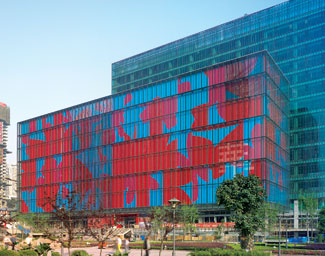
I believe that this shift in the understanding of my profession is well-founded. Not only will it help advance graphic design, as more cross-disciplinary firms come to the forefront it will break new ground. For instance, SOM, rock stars in the interior and architecture design world, won this year's only graphic design Gold in the prestigious 85th Annual Art Directors Club awards, for their graphics for the Jianianhua Center. The disciplines in the design profession are merging because designing for various media require the same approach to problem solving and today's technologies, as well as the proliferation of more skilled designers, make it easier.

The implications for sustainability, and for sustainable design, are huge because graphic designers are moving out beyond the basics. Today's graphic design industry is much like architecture during the early days of the USGBC’s LEED initiative. In its infancy, everyone was focused on the material content of products... e.g. recycled content vs. virgin content. Today's LEED's focus has expanded to include manufacturing processes, life cycle, performance and disposal... and is expanding still. As the idea of “design thinking” matures in my own profession, I believe the scope of what constitutes sustainable design will grow to include relevancy and necessity. In many firms it already does. I think it does at Tricycle.

Sustainable design is a process-oriented practice, concerned with the full life cycle of "stuff." Part of that life cycle includes marketing and aesthetics... the most obvious point where the craft of graphic design plugs in. I believe, and believe that AIGA and USGBC would agree, that designers have much more to offer than specifying a green product. It is not enough to design a nonprofit brochure on recycled paper or to specify a Cella chair, then claim environmental responsibility. It is time to rethink and redesign the life cycles of products, the processes of the businesses that make them, and the channels to market. This is how we design a sustainable society.

R Michael Hendrix is co-founder and Chief Brand Officer of Tricycle, Inc.

Our blog is mostly about sustainable design in the interiors industry,
especially carpet. Sometimes it's just about us. Updated when we've got something good to say.